- August 11, 2026
- Posted by: Rena Neville
- Category: Art Market, Blog

Last updated: 7 August 2026
Art market participants (AMPs) have faced two important AML developments in quick succession. The Money Laundering and Terrorist Financing (Amendment) Regulations 2026 came into force on 30 June 2026. HMRC then published substantially revised AML guidance on 8 July 2026.
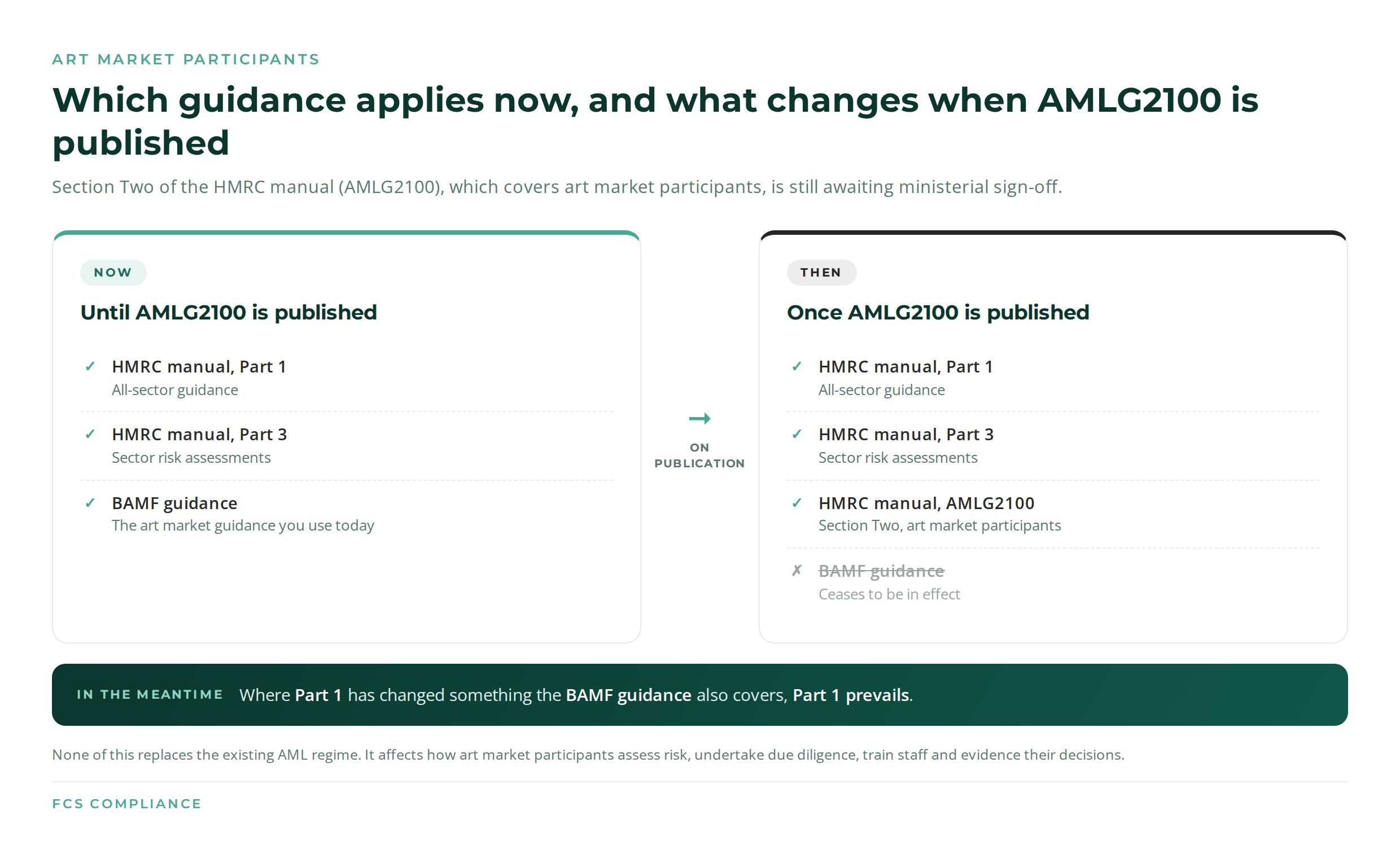
There is an important complication for the art market. Section Two of the new HMRC manual, which deals with art market participants (AMLG2100), has not yet been published and is awaiting ministerial sign-off. Until it appears, AMPs should continue to work to the British Art Market Federation (BAMF) guidance, alongside Part 1 of the manual, which is the all-sector guidance, and Part 3, which contains the sector risk assessments. Where Part 1 has changed an area the BAMF guidance also covers, Part 1 prevails, and when AMLG2100 is published the BAMF guidance will cease to be in effect. None of this replaces the existing AML regime, but it does affect how art market participants should assess risk, undertake due diligence, train staff and evidence their decisions.What changed in the Money Laundering Regulations?
 The most striking regulatory change is that the former €10,000 threshold is now in sterling
Since 30 June, the relevant currency for triggering customer due diligence (CDD) for art market transactions is set out in pounds sterling. As most of you know, the UK Money Laundering Regulations (MLRs) apply to business transactions in certain works of art, whether a single transaction or a series of linked transactions, of £10,000 or more. Less frequently discussed is the fact that the MLRs also apply to the storage of works of art in a freeport.
Because €10,000 was worth roughly £8,650, this is a real-terms increase of around 15 per cent, so a sale that previously sat just above the threshold may now sit below it. A sub-£10,000 transaction is still never an automatic free pass: the linked transaction test applies, and a sale below the threshold can still be suspicious. It is always important to consider other relevant matters, such as the Proceeds of Crime Act 2002. Please make sure that all your invoices, notices, contracts and so on now show the sterling figure.
What does HMRC’s new guidance mean in practice?
Annual Training Requirements Announced
The art market was previously advised to conduct “periodic training”. HMRC now expressly expects relevant employees and agents to receive AML training at least annually, with more frequent training where appropriate. Training should be refreshed following regulatory changes, emerging risks, changes in responsibilities, new technology or identified competency issues.
Relevant employees include those who contribute to identifying, preventing or mitigating money-laundering, terrorist-financing or proliferation-financing risks. Typically, these include front-of-house staff, specialists, client liaisons and some operations and accounts teams.
Moreover, all staff must be made aware of their Proceeds of Crime Act 2002 and Terrorism Act 2000 obligations and receive training on how to comply with these obligations, given the risk of personal liability. The training should cover the procedure around suspicious activity reports (SARs), including to whom to report, what to report, and when and why. Not all staff members will necessarily need training on every aspect of the AML programme, however.
Auditing Compliance with One’s Own Policies and Procedures
In our experience, many art market participants are not conducting spot checks. However, HMRC’s guidance on spot checks is straightforward. All art market participants should have what HMRC calls a “quality-assurance” procedure or mechanism to test whether the AML policies are actually being followed. Quality assurance testing, or spot checking, is often referred to as auditing. These checks should ideally be conducted by parties independent of the AML programme, whether internal or external. Quality assurance testing might include testing a sample of qualifying transactions and the customer due diligence records, to understand what was obtained, when and how it is stored. We urge art market participants to take HMRC’s guidance to heart.
New High-Risk Jurisdiction Considerations
The good news is that the circumstances in which enhanced due diligence (EDD) must be applied to high-risk third countries are now materially narrower than before. Mandatory EDD is required where a customer or transaction is connected to a country on the Financial Action Task Force (FATF) blacklist, formally called the Call for Action list. That list currently comprises Iran, North Korea and Myanmar.
However, the less good news is that the range of circumstances in which one must consider applying EDD is now much broader. If one chooses not to apply EDD after considering it, it is important to keep a written record of why EDD was not conducted.
Some of the criteria for when an art market participant must consider EDD include: countries on the FATF increased monitoring list, commonly called the grey list; countries vulnerable to corruption, in conflict zones, subject to sanctions or with weak financial reporting regimes; and citizenship-by-investment countries, and so on. The list also includes countries identified in the UK National Risk Assessment 2025, such as Russia, China, Hong Kong, Turkey and the UAE, as well as countries whose anti-money laundering and counter-terrorist financing regimes are not equivalent to the UK’s, such as the United States and China.
The Need to Reconsider Whether One Qualifies as a Larger Organisation
It is key to evaluate whether your business now qualifies as a “larger organisation” under the new guidance. Larger organisations now include those that:
- have more than one premises, or have branches or agents;
- have a high turnover of customers;
- have international transactions; or
- have complex ways of delivering services.
Some consequences of being a larger organisation include considering whether to appoint a separate Compliance Officer whose primary role is to audit compliance with the AML procedures and to implement a policy for checking right to work and unspent convictions, and so on. If you were not previously a larger organisation, this would require an updated risk assessment and policy.
What should art market participants do now?
Firms should:
1. GBP: Check that systems, consignment agreements and invoices carry the correct £10,000 sterling threshold, with no euro references left.
2. Consider the new HMRC internal manual as of July 2026: Review your firm-wide risk assessment against the new Regulations, Part 1 and Part 3 of the HMRC manual, and the BAMF guidance.
a. Update policies, CDD procedures and customer risk assessments where necessary.
3. Training:
a. Check when your relevant staff were last trained and arrange training if it was more than twelve months ago.
b. Organise all staff training on SAR-related topics.
4. Audit review: Review whether your own internal or external audits of your AML programme meet HMRC’s standards.
5. Larger organisation test: Ascertain whether your business now qualifies as a “larger organisation” and, if so, the changes to your policies, controls and procedures that must be made, including possibly appointing a Compliance Officer and beginning checks on right to work and unspent convictions, and so on.
6. EDD updates: Update your policies, controls and procedures to accommodate the new criteria on when enhanced due diligence is mandated, as opposed to when it must be considered. Be sure to add a procedure in which you document the reasons for those occasions when EDD is considered but not applied.
7. Simplified due diligence (SDD): Review your internal criteria for when SDD applies, how you record your decision-making, and how you apply it.
Existing AML documents are not automatically non-compliant. However, firms should be able to demonstrate that they have considered the changes and updated their framework where necessary.
Are your AML Policies, Risk Assessments and working practices still based on the previous HMRC guidance?
FCS Compliance can support art market participants through Policy and Risk Assessment reviews, staff training, all-staff training on SARs, due diligence file reviews and HMRC Inspection Readiness support.
Frequently Asked Questions
When did the new AML rules for the art market take effect?
What is the new AML threshold for art market transactions?
Which HMRC guidance should art market participants follow now?
When is enhanced due diligence mandatory for the art market?
How often must art market staff receive AML training?
About the author

Rena Neville
Head of FCS Compliance Art Division
Rena is a qualified lawyer and art market AML specialist. She enjoyed a 30-year career at Sotheby’s, becoming their first Global Compliance Director, having previously served as their European General Counsel and Global Head of Litigation. She brings a unique combination of art world and international legal experience. Leading the FCS Compliance Art Division, Rena helps Art Market Participants with the practical information and tools they need to meet their legal AML compliance obligations.