
FCS FATF Tracker
FATF Grey List and Black List
The Financial Action Task Force sets the global standards for tackling money laundering, and three times a year it names the countries with the weakest controls. Here is what the FATF does, how often it meets, and which jurisdictions sit on the grey list and the black list right now, shown on an interactive map and explained for UK property and art market professionals.
Lists last confirmed at the FATF Plenary, 17 to 19 June 2026. Next plenary: October 2026.
The FATF Tracker
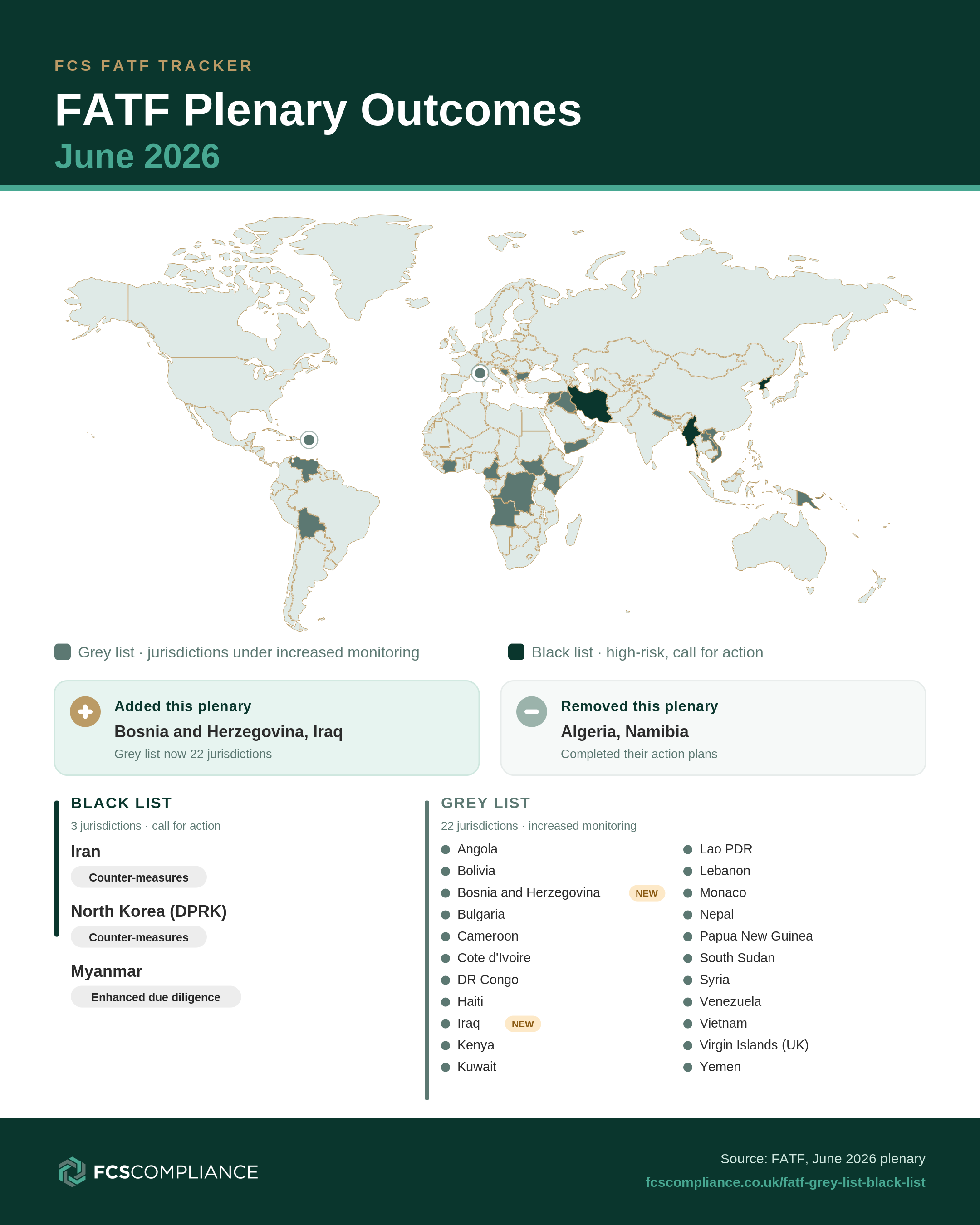
An interactive map of every country on the FATF grey list and black list, updated after each plenary. Hover or tap a highlighted country to see its status and when it was listed, and use the filters to isolate each list. Two micro-states, Monaco and the Virgin Islands (UK), are shown as markers because they are too small to fill on the map.
Download the map and share with your audience
Grab the June 2026 plenary outcomes as a ready-to-post graphic, with the map, the full grey and black lists and the latest changes. Free to share on your channels.
What is the FATF, and what does it do?
The Financial Action Task Force, or FATF, is the intergovernmental body that sets the international standards for combating money laundering, terrorist financing and proliferation financing. It was established by the G7 in 1989 and is made up of 39 members, including 37 member jurisdictions and 2 regional organisations, with a global network of regional bodies that extends its reach to more than 200 jurisdictions.
Its core output is a set of 40 Recommendations that countries are expected to write into their own laws. The UK money laundering regime, built on the Proceeds of Crime Act 2002 and the Money Laundering Regulations 2017, is designed to be consistent with them. The FATF also assesses how well each country meets the standards, and it publishes two public lists that name the jurisdictions with strategic weaknesses. Those lists are what most people mean when they talk about the FATF grey list and the FATF black list. For plain-English definitions of the terms used on this page, see our AML glossary.
How often does the FATF meet? The FATF holds three plenary meetings a year, normally in February, June and October. The grey list and the black list are reviewed and reissued after each plenary, so they can change up to three times in any twelve-month period. This is why screening against country risk needs to be a live process rather than a once-a-year exercise, and why a customer due diligence routine that captures country risk matters.
Grey list and black list: what is the difference?
Both lists flag higher-risk countries, but they carry very different expectations.
Jurisdictions under increased monitoring
Countries with strategic weaknesses in their anti-money laundering controls that have committed to fix them and are working with the FATF on an agreed action plan. The FATF does not call for enhanced due diligence to be applied automatically to grey-list countries, and it specifically warns against cutting off whole classes of customers. Instead, firms should factor the listing into a risk-based approach. In practice a grey-list connection is a prompt to look more closely, not an automatic block.
High-risk jurisdictions subject to a call for action
Countries with serious, unaddressed deficiencies. For these the FATF calls on all jurisdictions to apply enhanced due diligence, and in the most serious cases to apply counter-measures to protect the financial system. Two countries, Iran and North Korea, are subject to counter-measures. Myanmar is subject to enhanced due diligence rather than counter-measures. A black-list connection means heightened scrutiny is expected as a matter of course, and a clear high-risk third country trigger under the Regulations.
Who is on the list right now?
The current FATF lists, as confirmed at the latest plenary. Search by country, or click any country to focus the map above.
Black list
Grey list
No countries match your search.
What changed at the latest plenary?
Recent plenaries at a glance
What this means for your firm
A grey-list or black-list connection rarely arrives with a flashing label. It shows up as an overseas buyer, a company in the ownership chain, or funds routed through a listed country. Here is how to handle it.
Estate and letting agents
A buyer, a beneficial owner, or the source of funds linked to a listed country is a clear trigger to slow down and document the file. For black-list countries enhanced due diligence is expected; for grey-list countries, take a proportionate, risk-based view and record why you reached it. Remember that sanctions screening applies to every party and to lettings of any value, separately from the listing position.
FCS for the property sectorArt market participants
Cross-border buyers, intermediaries and consignors mean country risk is a routine part of art transactions. Where a transaction touches a listed jurisdiction, build the country factor into your due diligence on both the client and, where relevant, the object. Keep a clear record of the checks and the decision, so the file stands up if HMRC asks how you assessed the risk.
FCS for the art marketPutting it into practice
Screen for country risk
Check every party, beneficial owner and source of funds against the current FATF lists and the UK sanctions list as part of your customer due diligence.
Apply a risk-based response
Enhanced due diligence for black-list links and high-risk third countries; a proportionate, documented response for grey-list connections.
Record your decision
Write down what you found, what you did and why. A clear, dated note is what turns a judgement call into a defensible file.
Frequently asked questions
What is the FATF grey list?
The grey list, formally the list of jurisdictions under increased monitoring, names countries with strategic weaknesses in their anti-money laundering controls that have committed to address them with the FATF. The FATF does not call for automatic enhanced due diligence on grey-list countries, but firms should take the listing into account in a risk-based approach.
What is the FATF black list?
The black list, formally high-risk jurisdictions subject to a call for action, names countries with serious, unaddressed deficiencies. The FATF calls for enhanced due diligence on these countries and, in the most serious cases, for counter-measures. As at the June 2026 plenary it comprises Iran and North Korea, which are subject to counter-measures, and Myanmar, which is subject to enhanced due diligence.
How often does the FATF update the lists?
The FATF reviews and reissues both lists after each of its three plenary meetings a year, usually held in February, June and October. Countries can be added or removed at any plenary, so the lists should be checked regularly rather than annually.
Which countries are on the FATF grey list in 2026?
As confirmed at the June 2026 plenary, the grey list contains 22 jurisdictions: Angola, Bolivia, Bosnia and Herzegovina, Bulgaria, Cameroon, Cote d’Ivoire, the Democratic Republic of the Congo, Haiti, Iraq, Kenya, Kuwait, Lao PDR, Lebanon, Monaco, Nepal, Papua New Guinea, South Sudan, Syria, Venezuela, Vietnam, the Virgin Islands (UK) and Yemen. Bosnia and Herzegovina and Iraq were added at that plenary, while Algeria and Namibia were removed.
Does a grey-list connection mean I must refuse the customer?
No. The FATF specifically warns against cutting off whole classes of customers. A grey-list connection is a prompt to apply a proportionate, risk-based level of scrutiny and to document your decision, not an automatic reason to decline business.
What is the difference between the FATF list and the UK sanctions list?
They are separate. The FATF lists flag countries with weak anti-money laundering systems and inform your risk-based due diligence. UK financial sanctions, maintained by the Office of Financial Sanctions Implementation, prohibit dealing with named designated persons and apply to everyone in the UK regardless of value. You need to screen against both.
Not sure how country risk fits into your AML checks?
FCS Compliance helps regulated property and art businesses build country risk into their due diligence, risk assessments and policies, so you stay ready for HMRC. Talk to our team about a compliance health check.
Speak to FCS Compliance Explore our servicesAbout this page. The country lists reflect the FATF statements issued at the plenary dated above and were verified against the Financial Action Task Force website (fatf-gafi.org). This page is reviewed and updated after each FATF plenary. Last reviewed 22 June 2026.
This page provides general information only and is not legal advice. The FATF lists change, and the next plenary may add or remove countries. Always confirm the current position against the FATF and the UK sanctions list when assessing a specific transaction.